

Doonesbury Kills Satire
Beloved political cartoonist gets his "unopposed" biography, retires

When asked if he had read Kendall’s biography yet, Garry Trudeau said it sat atop his pile of summer beach reads, “Where my shrieks of mortification will mix with the screeches of the sea gulls…”
This review runs next week in the Los Angeles Review of Books, June 25, 2026
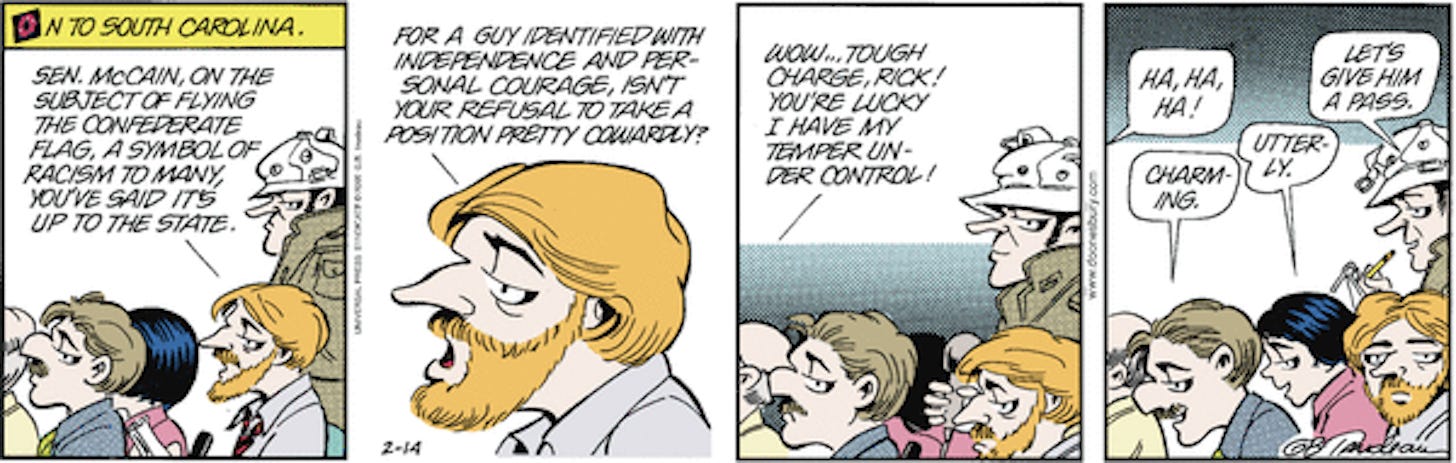
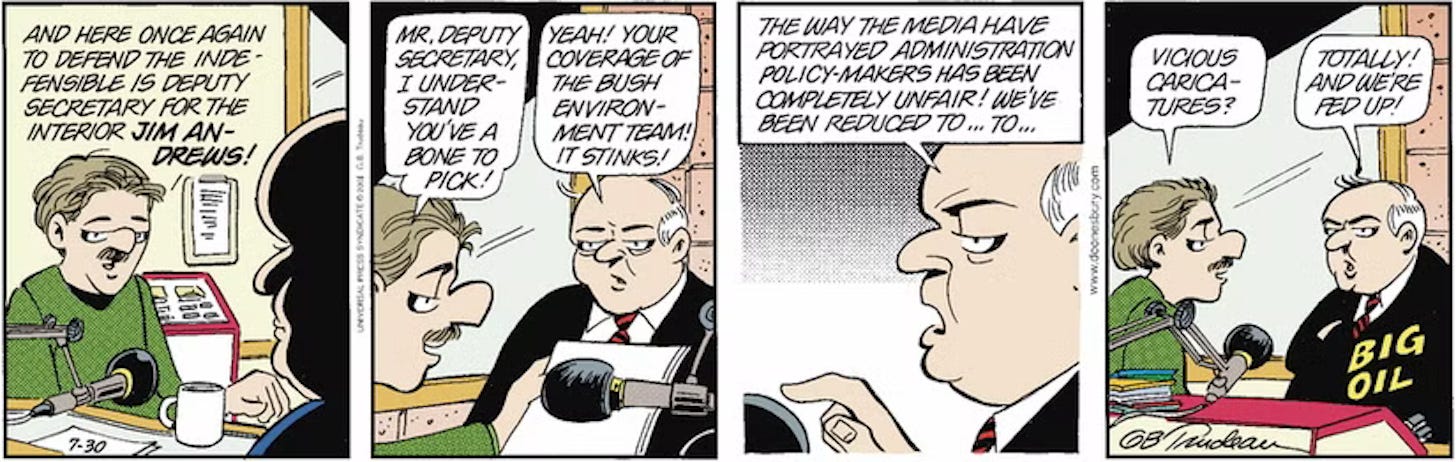
GARRY TRUDEAU ARRIVED in the daily funny pages in 1970 with rock and roll’s moral clarity in his ears: a refusal to accept the consoling lies of the establishment, a willingness to make older readers uncomfortable, and an instinctive grasp of form and content. Like Jimi Hendrix overturning the national anthem at Woodstock, Trudeau inverted the comic strip itself; a form designed to provide morning comfort became a delivery system for outrage, generational confrontation, and the fury of someone young enough to face the draft lottery but privileged enough to escape it. Joshua Kendall’s authorized biography, Doonesbury: The Cartoonist Who Turned the News Into Art, documents this achievement with thoroughness and affection, but it sidesteps the harder question Trudeau (and rock and roll) now faces: what happens when a revolutionary form gets absorbed into the machine it set out to demolish?
The parallel to rock and roll reaches beyond aesthetics. Rock’s first wave gave us Elvis and Little Richard, and then came the Beatles, who in their heyday carried strong subversive currents. But rock quickly faced the same gravitational pull toward respectability. The Beatles went from Hamburg’s Reeperbahn to the Ed Sullivan Show; Trudeau went from campus dailies to 1,400 newspapers and 60 million readers at his 2004 peak. And like rock, Doonesbury possessed an ear sharp enough to gall even its supposed allies. Most D.C. speechwriters considered it a victory if Trudeau simply left their bosses alone. The strip had teeth. For nearly five decades, he sustained a velocity that conventional journalism—bound by objectivity protocols—could never match. When newspapers hesitated to probe George W. Bush’s National Guard service, Trudeau simply posted a $10,000 bounty on his website for proof of this service, ridiculing both Bush’s privilege and journalists’ incompetence.
When newspapers hesitated to probe George W. Bush’s National Guard service, Trudeau simply posted a $10,000 bounty on his website for proof of this service, ridiculing both Bush’s privilege and journalists’ incompetence…
Yet both movements ultimately demonstrated the same paradox: once you reach 60 million people, you have already compromised the message that got you there. The system you once railed against now awards you Super Bowl half-time shows and Royal Knighthoods.
To understand Trudeau’s particular wrath, Kendall traces his development back to Yale in 1966—the last all-male class before coeducation and the first to face the draft lottery since World War II. It was a pressure cooker of privilege and dread, and Trudeau sat on its fault lines. Like a lot of his generational peers, his low lottery number—27—made his prospects for Vietnam ominous. He famously drew a self-portrait wearing an army helmet emblazoned with that number, driven by the same calculation that prompted the young John Kerry in 1971 to ask the US Senate, “How do you ask a man to be the last man to die for a mistake?” That same year, the Pentagon Papers capsized the Pentagon’s propaganda…
more
The Washington Post’s timeline, archive
secrets learned

Madonna: The Complete Catalog podcast, with Tristan Ettleman
Madonna:Illustrated by Tim Riley (bookshop.org, ebay)
noises off
From the archives: Kansas post-punk lifers the Embarrassment get their close-up in a documentary with tons of early live footage; Chuck Berry biographer RJ Smith on listening past the man’s indefensible behavior; and the late pianist Lars Vogt’s last recording
Instagram links: the New Gigantism, sucking time beyond space itself, reels and highlights saved across Tools, Journalism, Rock, Beatles, Dance, Posters, and Misc
riley rock index: obits, bylines, youtube finds, reference sites, pinterest, beacons.ai, random deep link

drop a dime on good criticism

I don't think I was a particularly precocious kid, but there was something about the strip's droll wit/satire that resonated with me far more than any other strip (or political cartoon) ever could.
I didn't know he was alive.